RFSense
Deep-learning pipelines for automatic modulation classification and the RF-based detection and fingerprinting of unmanned aerial vehicles.
Overview
Turning raw I/Q samples into reliable signal decisions.
This ongoing project builds deep-learning pipelines that take raw in-phase / quadrature (I/Q) samples from a software-defined radio and classify them — first by modulation type (automatic modulation classification), then by emitter identity, including the detection and fingerprinting of small unmanned aerial vehicles.
The work spans the full stack: SDR data capture, time–frequency feature design, and model architectures evaluated under the noise, fading and hardware impairment of real RF channels. It is early-stage research — the pipelines, captures and observations below evolve as the work matures, and nothing here should be read as a final benchmark.
Approach
From waveforms to decisions, with models that respect the physics of the channel.
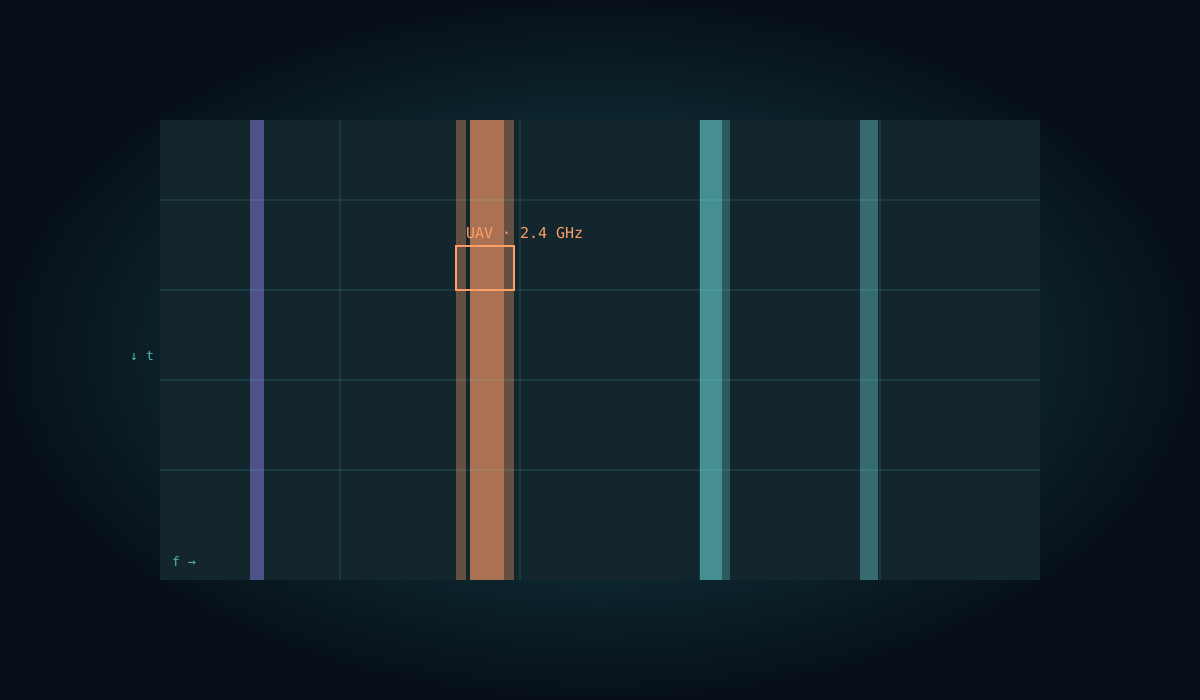
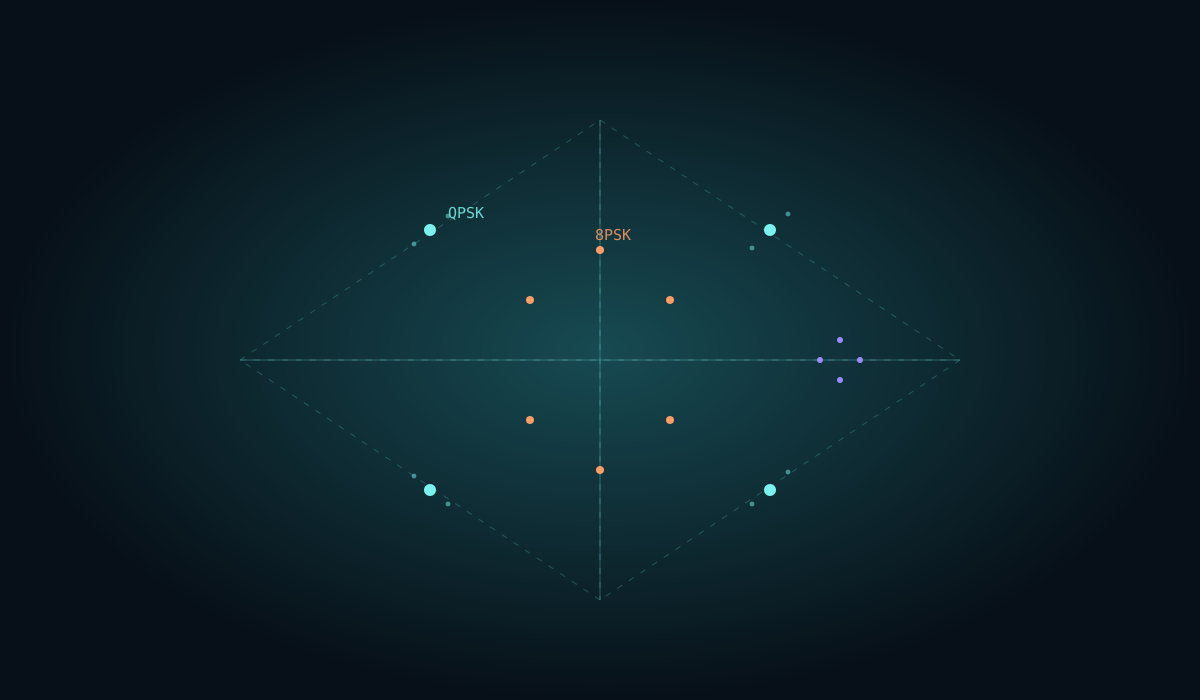
Inputs are raw I/Q samples and their time–frequency representations (spectrograms and constellation views). Models range from compact CNN baselines to ResNet and Transformer architectures, compared on their ability to classify common digital modulations (PSK, QAM, OFDM) and to separate UAV control-link emissions from background traffic and noise.
A particular focus is robustness: how accurately a classifier holds up at low signal-to-noise ratio, under channel fading, and across the distribution shift between controlled captures and field recordings — the gap that most often breaks lab-trained RF models.
Status & roadmap
Currently in the data-collection and baseline-modeling phase.
Planned next steps: expand the software-defined radio capture set across more modulation types and UAV models; benchmark robustness at low SNR and under fading; and prepare the manuscripts listed in the publications library. Code and captures will be released here as the work stabilizes.
If you work on RF signal identification, UAV detection or related deep-learning methods and would like to collaborate, the contact links below are open.